Job Title:               Programme Officer — Research

Reporting to:        Programme Head — Research & Policy

Duration:               2 years, renewable

Application:           Friday, February 12, 2021

The right candidate for this programme officer position, within PASGR’s Research and Policy Unit, will be able to take initiative in connecting, informing and fostering exchange among relevant research, policy practice and advocacy constituencies working on selected issues of governance in Africa; in identifying and engaging funding and partnership opportunities for the research unit, coordinating routine communication and arrangements for the research unit operation in the region. The candidate will develop and grow work along five key areas of responsibilities:

  1. Project coordination;
  2. Substantive knowledge of public policy, development and governance theories and practices;
  3. Technical support;
  4. Capacity building;
  5. Research and Documentation;
  6. Monitoring and evaluation;

S/he will be comfortable with tight deadlines, and adept in setting relevant priorities and working in a self-directed and proactive manner, while knowing when and where to support where needed.

Key Responsibilities 

  • Support the development and implementation of PASGR’s flagship research uptake and use programme – Utafiti Sera –  initiatives at regional and national levels;
  • Support the overall institutional and research programme plans, including resource mobilization for programme sustainability;
  • Participate in the development of plans and mobilization of resources for further policy strengthening initiatives at regional or national levels;
  • Establish a comprehensive database of institutions and individuals actively engaged in research, research uptake, advocacy, and practice in Africa;
  • Coordinate and support the management of PASGR Research Unit’s internal and external communication with relevant actors, stakeholders and the public;
  • Provide managerial and technical support to the head of research and policy;
  • Participate in strengthening existing M&E systems at all levels of the programme including supporting research programme grant recipients and Sub-recipients to meet programme deadlines and deliverables;
  • Participate in documentation and dissemination of new lessons and experiences and in the implementation of research projects/studies;
  • Participate in relevant PASGR activities, as needed.

Requirements

  • Master’s degree in the social sciences, development, governance or related fields.  However, candidates who are either completing PhD or those who have obtained a PhD within the past two years are encouraged. Working knowledge of French will be an added advantage;
  • At least three (3) years of post-qualification work experience in the field of social science  including engagement with policy, practice and government constituencies;
  • Experience of managing projects, events and stakeholder engagement including budgets and budget tools; 
  • Excellent writing and oral communication skills;
  • Familiarity with the development of concepts for research or other projects and with the search for- and engagement of funding opportunities;
  • Evidence of willingness to work as part of a team;
  • Proven ability to multitask and work in a self-directed and self-driven proactive manner without supervision;
  • Proven ability to actively reach out to and forge strategic connections and partnerships with a spectrum of stakeholders.

Salary

This position attracts a competitive package that includes: basic salary, dependent education, pension plan and medical insurance.

Application Process

Applications must be submitted electronically via email to PASGR (recruitment@pasgr.org) by Friday, February 12, 2021 at 1700hrs.  All applications must contain Curriculum Vitae and 3 references.  Provision of any one of the reports cited in the CV will be beneficial.

PASGR is an Equal Opportunity Employer.
Hundreds of academics at 28 universities across the African continent are facing online teaching and learning in 2021 head-on, thanks to a training initiative preparing them for the challenges of the year ahead.

When COVID-19 hit the world in 2020, higher education in many African universities was in chaos. Some institutions closed, and others were not adequately prepared to shift the delivery of their programmes to the virtual space.

Besides infrastructural challenges, many university teaching staff lacked digital competencies to facilitate teaching and learning online.

This was exacerbated by a predominantly poor attitude towards online programmes which are perceived as inferior to face-to-face programmes.

To combat the problem and prepare teachers for the ‘new normal’, the Partnership for African Social Governance Research (PASGR) in Nairobi, through its Partnership for Pedagogical Leadership in Africa (PedaL) programme, organised an online training programme to prepare African academics for online teaching.

PedaL is one of nine partnerships of the UK’s Foreign, Commonwealth and Development Office’s Strategic Partnerships for Higher Education Innovation and Reforms, implemented by PASGR in partnership with African Research Universities Alliance, the UK’s Institute of Development Studies, the University of Sussex, Nigeria’s University of Ibadan, the University of Ghana, Uganda Martyrs University, Tanzania’s University of Dar es Salaam and Egerton University in Kenya.

The pilot programme was launched in June 2020.

Effective use of educational technology

PedaL’s training programme is designed to help educators better understand how to design their courses to make better use of educational technology – in both blended and fully online modes.

The trainees cover fundamental concepts and are immersed in the practical application of a variety of toolsets, digital resources and strategies for course planning and design as well as creative facilitation and innovative assessment.

Dr Beatrice Muganda, the director of higher education at PASGR, said the design of the course captured the African values of ubuntu and working together to utilise the available limited resources to prepare academics for online teaching.

“The pairing of trainees with peer educators helped us achieve a high completion rate of 72%,” said Muganda, adding that it was not common to achieve a higher completion rate than 50% for online courses.

In an interview with University World News, Muganda said that the programme design helped ground academics in the art and science of online teaching and learning by focusing on three interlinked aspects of online teaching and learning: planning and design of online and blended courses; creative facilitation; and innovative assessment of learning outcomes.

“A few months [have passed] and PedaL online is counting a number of big wins. The programme is helping to focus academics on adapting rather than feeling helpless in the midst of a ravaging pandemic,” Muganda added.

Online training soaring

Professor Stephen Kiama, the vice-chancellor of the University of Nairobi, Kenya, said that PedaL’s interventions “capture the essence of what learning and adapting new ways is all about”.

Muganda agrees. “At a time when we are talking of reimagining Africa’s higher education, PedaL comes in handy because the future is blended teaching and learning for our universities.”

According to Muganda, the demand for PedaL online training is soaring. To date, 547 academics (237 female and 310 male) from 28 universities in six African countries have completed the training.

Several trainees said the programme had helped them rethink their digital facilitation strategies despite the challenges they face at their institutions.

“My thinking of online was to post PowerPoints and notes until PedaL happened. Bloom taxonomy was a cliché, but now I can relate,” said Dr Bessy Kathambi from the Wangari Maathai Institute for Peace and Environmental Studies at the University of Nairobi.

“My turning point was that I should always go to the class with learning outcomes.”

Dr Aderonke Akinpelu from the department of physiotherapy at Ibadan University, Nigeria, said the training has helped her to discover that her teaching and assessment strategies needed an update.

PedaL’s online engagement rose from 16,450 hits in September 2019 to more than 110,000 hits in December 2020.

“This further demonstrates a renewed interest in online programmes and the use of educational technologies for e-learning; previously perceived as less valuable and difficult to use respectively,” Muganda said.

To meet the growing demand for PedaL training, Muganda said PedaL’s partners are exploring partnerships with individual universities. A collaborative agreement has been set up with the University of Nairobi to offer the training through its Centre for Pedagogy and Andragogy.

This has been reposted from https://www.universityworldnews.com/post.php?story=20210111125339374

Deadline: Midnight EAT, Sunday 29th November, 2020

Please submit your CV and 1-side cover letter to apply, and/or share this with colleagues who may be interested.

Who can apply to the programme?
 
We are looking for mid-career leaders in the water security or WASH sector – whether working for part of the government, an NGO, private sector, research institute or other. Focus country are Tanzania, Ethiopia and Kenya, but applications from elsewhere in Africa are also welcome. 

The training will entail 2 hours online seminars between 11am and 1pm EAT once per week for 9 weeks, plus 1-2 hours additional materials to be completed at any other time each week. 

The training is free but space is limited – participants will be selected based on applications that show strong motivation to work on accountability, relevant skills and experience, and potential to proceed to the Professional Research Fellowship programme.

The masterclass will build knowledge and understanding of accountability in the water sector, and research methods. Completion will be recognised by a certificate of attainment.

The learning will be structured to support the preparation of a research proposal to submit for  the Professional Research Fellow (PRF) grant, so if you think you might want to submit a proposal for this programme you are strongly encouraged to apply for the training. The PRF research grant is for your employer to support you to complete research (supported by the programme with training, mentoring and research costs)  within your scope of work, during your normal hours of employment. (Approximately 90 days over 18 months).  It will therefore be important that you will be supported by your employer to proceed with the PRF part of the programme. Find out more about the programme here: www.accountabilityforwater.org


1-side cover letters should include a very brief summary of:

  1. Your current role and how it relates to accountability in water
  2. Whether you have discussed the opportunity within your organisation and have support to engage during the working day / develop a research proposal
  3. What research question or area (related to accountability for water) you think is important and would be interested to investigate.

Click on  Briefing Note here

Contact person: Lauren Wesonga- lwesonga@pasgr.org

Accountability for Water is a new programme of action & research to improve water governance & water service delivery. Too often good policies, wise laws and promising programmes have failed because of weak accountability.

To harness the potential of stronger accountability we need to know ‘what works and why?’ in different water management contexts.

We invite you to join us and support our three goals for water security:

  • Knowledge generation: Sector leaders supported to do high-value research
  • Outreach and uptake: Sharing findings through meetings, publications and online
  • Ensuring legacy: Developing strategies, support networks and implementation plans

Become a Host Organisation

Any organisation with an interest in accountability can be a host organisation-government agencies, utilities, civil society or researchers. With a PRF research grant you can support a member of your team to complete research on your priority accountability issue.

Become a Professional Research Fellow

Fellows will be professionals who sit within a host organisation who are capable of carrying out original research, with training & mentoring support from a wide range of organisations and experts including leading researchers. Learning Partners are welcome to join. Contact us to receive regular updates and share your learning with us.

Our 9-week remote-learning masterclass on Accountability for Water begins on 16th November 2020. Participants will receive a certificate of attendance and coaching to develop a Research Fellowship Proposal for an 18 month research grant. To register interest and find out more, and to register for our launch event on 5th November 2020 (online -2pm EAT):timbrewer@waterwitness.org

The University of Pretoria’s School of Public Management and Administration (SPMA) will offer a new PhD programme in Public Policy, and prospective students will be able to apply for it in 2021. 
This development comes as a result of engagements between the SPMA and the Partnership for African Social and Governance Research (PASGR) in 2019, when UP staff met with Dr Beatrice Muganda, Dr Pauline Ngimwa and Executive Director Professor Tade Aina from PASGR. 
“The University has recently signed a Memorandum of Agreement with PASGR and we believe this will just strengthen the very good relationship the SPMA has formed with PASGR over the last year,” says Prof Natasja Holtzhausen, SPMA PhD coordinator. 
One of the discussion points was a PhD programme with a strong policy focus. With the support of the Faculty of Economic and Management Sciences and University management, Prof Holtzhausen and SPMA colleagues wrote a proposal that was submitted to all the relevant university committees to obtain permission for a degree that specialises in public policy. Top prospective students from across the continent were targeted. The Carnegie Foundation made 15 full scholarships available to fund exceptional PhD students. These 15 scholarships were shared among the three universities that were piloting the PhD, these being the University of Ibadan in Nigeria, the University of Nairobi in Kenya, and the University of Pretoria. 
The first students, mainly from Uganda and Nigeria, enrolled at UP in January 2020, but under the PhD Public Administration and Management programme. The PhD degree in Public Policy has since been approved by Senate and as of 2021, prospective students will be able to apply for this specific degree.

This has been reposted from https://www.up.ac.za/school-of-public-management-and-administration/news/post_2929457-spma-to-offer-new-phd-in-public-policy

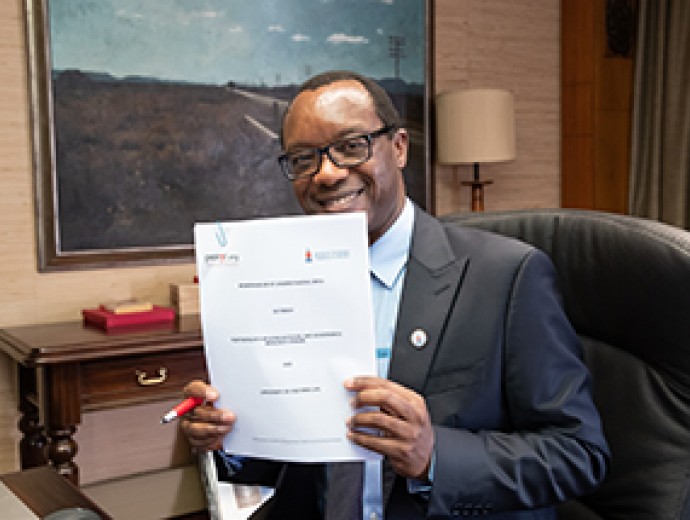
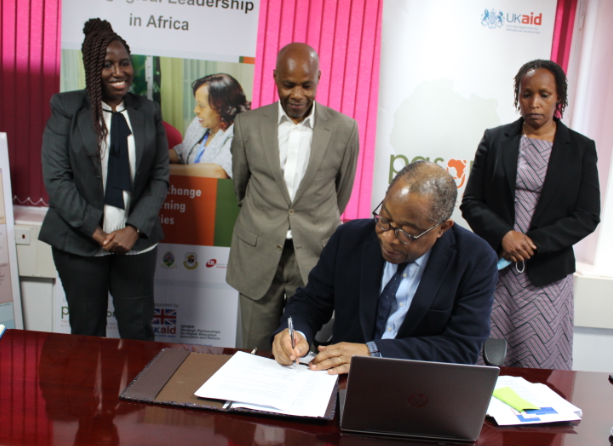
University of Pretoria (UP) Vice-Chancellor and Principal Professor Tawana Kupe and Partnership for African Social and Governance Research (PASGR) Executive Director Professor Tade Aina formalised the strategic partnership between the two institutions during a virtual signing ceremony of a memorandum of understanding (MoU) on Monday, 21 September.

PASGR is a pan-African non-profit organisation established in 2011 and located in Nairobi, Kenya, with engagements in over 25 African countries focused on enhancing research excellence in governance and public policy for society’s overall well-being. The strategic partnership between UP and PASGR will be anchored by the collaborative Master’s Programme in Research and Public Policy and the Doctoral Programme in Public Policy offered together with the University of Ibadan and University of Nairobi. Collaboration will also focus on research and policy training for early and mid-career researchers, and collaborative research grants on important policy issues in Africa.

The partnership with PASGR is very much aligned to UP’s strategic goal to become the leading African-global university. This strategic goal seeks to develop a globally competitive and recognised research institution responsive to societal challenges, particularly in Africa. UP’s four transdisciplinary platforms, (i) the Future Africa Campus and Institute, (ii) Javett Art Centre, (iii) Engineering 4.0, and Innovation Africa@UP will play a leading role in this regard. For the UP-PASGR collaboration, Future Africa will be an instrumental science-policy platform for hosting transdisciplinary teams of researchers and practitioners, including policymakers from the continent and the rest of the world in the co-creation of knowledge to address complex governance and public policy challenges facing Africa.

During the virtual ceremony, Prof Kupe noted that “this MoU provides a visible manifestation of agreed strategic collaboration and a shared commitment to the leveraging of our collective intellectual capital, expertise, resources, and capacities in the advancement of our well-aligned visions and strategic priorities”.

PASGR Executive Director Prof Aina added that the MoU “is also a reinforcement for building the next generation of public policy researchers and leaders in Africa”. 

This has been reposted from https://www.up.ac.za/news/post_2924288-up-formalises-strategic-alliance-with-the-partnership-for-african-social-and-governance-research-pasgr

A new partnership between South Africa’s University of Pretoria and the Kenya-headquartered Partnership for African Social Governance Research (PASGR) will boost capacity-building, especially for postgraduate students and early- to mid-career researchers in Africa.

The collaboration, formalised this week (21 September) during a virtual meeting of senior staff from the two institutions and other higher education experts from Africa, will be led by the University of Pretoria (UP) and PASGR and implemented in collaboration with Nigeria’s University of Ibadan and Kenya’s University of Nairobi.

The partnership will be anchored under five flagship programmes of PASGR, including the collaborative doctoral programme in public policy to be offered by UP, University of Ibadan and University of Nairobi. For this programme, PASGR has received seed funding from the Carnegie Corporation of New York to support 15 fellows and pilot the doctoral programme at the three universities.

Other programmes include a collaborative masters programme in research and public policy; a pedagogical leadership in Africa programme; a research and policy training programme for early- to mid-career researchers; and collaborative research grants relating to important public policy issues in Africa.

According to a statement about the partnership, it will also focus on strengthening public policy through other initiatives such as the research partnership programme between UK Research and Innovation (UKRI) and the African Research Universities Alliance’s (ARUA) Food Systems Research Networks for Africa project which seeks to “strengthen food systems research capabilities and the translation of evidence into implementable policy solutions and practical interventions” in support of the United Nations’ Agenda 2030 on Sustainable Development.

“Partnerships are key to how higher education should be reimagined post COVID-19,” said UP Vice-Chancellor Professor Tawana Kupe.

“This collaboration will establish a model for partnership between universities and non-profit organisations,” said Kupe.

PASGR Executive Director Professor Tade Aina described the partnership as another “landmark event” in building excellence in social sciences, the arts and humanities.

“This is an intellectual and academic relationship that is central to Africa and will bring out the innovation, creativity and work needed to build the continent,” said Aina.

He said despite the challenges facing African universities and countries, the partnership should pave the way for further collaborations aimed at building better universities.

UP Director of Institutional Planning Dr Gerald Ouma said collaborations had become a necessity and this was amplified by COVID-19. He said the continent would need more international networks of collaboration to support young and upcoming academics and early- to mid-career researchers.

Dr Beatrice Muganda, Director of Higher Education Programme at PASGR, said the partnership would help students across Africa to develop competencies for shaping public policy across a wide spectrum of sectors, from social issues such as identity crises, to migration, security, food systems and public health.

She said it would help students and academics from Africa to benefit from the knowledge and skills of the host universities.

Kupe described the partnership as a South-South collaboration that will help develop knowledge that can be translated into programmes solving critical issues of development in Africa.

Professor Karuti Kanyinga, a PASGR board member, said it would give international visibility to African intellectual products and help to drive an agenda that is anchored on African ideals and help to bridge interdisciplinary gaps.

Kanyinga expressed concern that many countries in Africa still neglect research and evidence in policy-making, a culture the partnership will endeavour to change, he said. “This partnership will help lobby African governments to use evidence in decision-making. The more we have such partnerships, the greater the voice of African scholars in policy-making.”

This has been reposted from https://www.universityworldnews.com/post.php?story=2020092313380718

The PedaL project is a platform to revolutionize the teaching narrative by updating the pedagogical skills of African university teachers. The PedaL integrated model comprises six major components, namely, pedagogical strategies, educational foundations, technology-enhanced teaching and learning, curriculum and learning design, pedagogical leadership practice, and assessment. PASGR targets creating a vibrant African social science community that addresses the continent’s public policy issues. Read more

As online and blended teaching and learning become part of the new normal, the need for specialist training of academic staff is being realised.

Last month, a three-week course designed by the Partnership for African Social and Governance Research (PASGR) and intended to teach lecturers how to design, prepare and assess online courses, attracted 100 lecturers from universities in Botswana, Ghana, Kenya, Nigeria, South Africa, and Uganda.

The pilot training was part of the Partnership for Pedagogical Leadership in Africa (PedaL) programme. PedaL is one of the nine partnerships of the United Kingdom’s Strategic Partnerships for Higher Education Innovation and Reforms, aiming to catalyse systemic change in teaching and learning in African universities.

The initiative has trained over 1,100 academics from 60 African universities and is implemented by PASGR in partnership with the African Research Universities Alliance, Nigeria’s University of Ibadan, University of Ghana, Uganda Martyrs University, Tanzania’s University of Dar es Salaam and Egerton University in Kenya.

Students at the centre

Audited by the Commonwealth of Learning, INASP (International Network for the Availability of Scientific Publications), and the Association of Commonwealth Universities, the online course provided a platform for academics to share knowledge and ideas on how to improve pedagogy and ensure that students are at the centre of learning through online or blended learning.

The facilitators of the pilot training used a range of teaching tools such as case studies, simulations, concept maps, role plays, and authentic tasks to spur experience sharing, critical thinking, problem-solving, and collaboration among participants.

Dr. Beatrice Muganda, the director of the Higher Education Programme at PASGR, said the design of the course enabled lecturers and facilitators to work collaboratively.

“The programme to deliver courses online must be exciting for students in the way they are structured so as to meet the desired learning outcomes. The strength of PedaL is that everything we do is transferable to the classroom, whether physical or virtual,” Muganda told University World News.

Muganda said that the training would bring about the “transformation that we hope translates into learning”. However, she said the lecturers will still have a month to access the online resources and consult the course facilitators so as to increase the depth of learning.

Technology as facilitator

Contrary to some fears, online teaching requires more lecturer engagement than before, she said, referring to concerns that technology could replace teachers. “Technology won’t do everything for us but may make our work easier, even in terms of evaluating students,” Muganda said.

She added that even after the official end of the online pilot training programme, academics continued with self-paced learning, uploading courses at 3 am. This, she said, implies that the continent is creating a new cadre of academics who spend much of their time planning for their students.

“Before the coronavirus pandemic, everybody had something to say about online and blended teaching but no institutions put in place the machinery for online learning,” said Professor Tade Aina, the Executive Director of PASGR.

Aina, who formerly was the programme director of the Higher Education and Libraries in Africa Program for the Carnegie Corporation of New York, said PASGR was already considering online and blended learning, especially for the PedaL programme, before the pandemic hit.

Increased access to pedagogical transformation training

“We were keen on this so as to increase access to our pedagogical transformation training in the continent … This implies that physical training could not be sufficient to reach as many academics as possible,” Aina told University World News.

Aina urged academics to ensure that technology-enhanced learning was simple, engaging, transferable, and comprehensive. He said the positive responses from participants to the pilot training show that online and blended learning is inevitable in Africa, despite challenges such as blackouts and unreliable internet coverage.

“The most important thing is getting ways to support lecturers and students for online learning. It’s work in progress; we shall have errors and hitches but we will finally get there,” Aina said.

Fourth industrial revolution

He challenged African universities to prepare for a culture of online delivery and assessment, arguing that the pandemic was hastening Africa into the fourth industrial revolution.

“There will be a high dependence on machine learning and artificial intelligence. University leadership should be preparing for this by completely reforming our research and development so that we are not just consumers but also innovators,” said Aina.

Khaemba Ongeti, associate professor in the department of curriculum and instruction at Moi University’s School of Education in Kenya, said the work of the lecturer had expanded with the emphasis on remote teaching and learning.

“Online teaching will also require lecturers to constantly review what they are doing to ensure that students’ interest in learning is kept high,” said Ongeti, adding that supporting learners will be critical to achieving desired learning outcomes.

Participants said the course was an eye-opener with regard to revealing the tools available online to help them.

“I join all participants in expressing my profound gratitude to PASGR and her partners for this opportunity to acquire 21st-century skills,” said Dr. Ndidi Ofole, one of the trainees and a senior lecturer from the University of Ibadan. Her colleague, Sella Terrie Jwan from Moi University, said the training was taxing but fulfilling, leaving her empowered to move with speed and start practicing online teaching.

This has reposted from https://www.universityworldnews.com/post.php?story=2020070716115125

Title: Programme Assistant (Professional Development, Training and Fellowships Programme)

Reports to: Programme Manager

Location: Nairobi, Kenya

 Open to: Kenyan Residents and Nationals

Duration: 1 year contract (Renewable)

Application deadline: Wednesday, July 8, 2020 (1700hrs Kenyan Time)

Background

The Partnership for African Social and Governance Research (PASGR) is an independent, non-partisan pan-African not-for-profit organisation established in 2011 and located in Nairobi, Kenya.  PASGR is working in more than 14 African countries to enhance research excellence in governance and public policy that contributes to the overall well being of the citizens.  Our vision is ‘a vibrant African social science community addressing the continent’s public policy issues’.

In partnership with individual academics and researchers, higher education institutions, research think tanks, civil society organisations, business and policy communities both in the region and internationally, PASGR supports the production and dissemination of policy relevant research; designs and delivers short professional development courses for researchers and policy actors; and facilitates the development of collaborative higher education programmes and manages fellowships to support scholarship and research.

Professional Development, Training and Fellowships is one of the three core PASGR’s programmes responsible for research capacity strengthening and administration of fellowships.

 Key Responsibilities

  1. Training Support
  • Support the training function of the programme including marketing of the programme, call for application preparation, selection process, invitations for participation, source for training venues, instructors’ logistical supports including travels and accommodation, and training materials preparation.
  • Support to the digitization of the PDT courses and delivery of online courses.
  • Support to the management and capacity strengthening efforts of the body of instructors

2. Coordination of Fellowships

  • Provide support to the Programme Manager and the Higher Education Programme team in the coordination and implementation of fellowships, including selection of fellows.
  • Assist with the implementation of the fellowships’ activities including the Joint Annual Academic Seminars.
  • Manage timely payment of fellowships related costs.
  • Facilitate and manage communication with fellows.
  • Support donor engagement by preparing and availing documents required for grant management and reporting.

3. Resource Mobilization

  • Identify and disseminate funding opportunities to programme teams.
  • Working with Programme teams, participate in the entire proposal development of identified funding opportunities.

4. Programme Implementation Support

  • Support and carry out monitoring and evaluation of the Programme activities.
    • Provide support in the preparation and tracking of PDT budgets, procurement of services, processing of payment requests and budget reconciliations.
    • Take charge of all programme’s documentation including print and electronic filing to ensure safe storage and easy retrieval of PDT information. This also includes maintaining of an updated contact database.
    • Set up Programme’s virtual and physical meetings including taking minutes and ensuring that agreed action points are well documented and actioned.
    • Prepare programme’s reports, service contracts, presentations, including editing and formatting.
    • Receive and respond to general enquiries about the Programme, as well as to requests from partners and collaborators.
    • Handle all logistical support for training workshops and meetings.

Competences

  • Initiative, creativity, enthusiasm, maturity, tact and high sense of responsibility.
  • High level of computer literacy.
  • Ability to learn new tools, tasks and skills quickly.
  • Attention to detail.
  • Excellent organisation skills.
  • Professionalism and adherence to deadlines.
  • Excellent oral and written communication in English.
  • Ability to work independently, set priorities, juggle tasks and meet tight deadlines.
  • Excellent interpersonal skills and ability to establish and maintain effective working relations with people in a multicultural and multi-ethnic environment.

Qualifications and Experience

  • Masters in any of the Social Sciences, Education or related disciplines such as Business, Communications and Development Studies.
  • Post qualification experience in any of the following areas preferably with an international or similar regional/ national organization would be an advantage: fundraising and proposal writing; coordination of training programmes; programme management, Monitoring and Evaluation; advocacy; policy engagement.

How to Apply

Applications should be sent to info@pasgr.org by July 8, 2020. The email must include: a CV and a cover letter.